Barrister Training Course

Bar Course | BPC | BTC | BVS
Develop the Practical Skills Required for the Bar
The UK Barrister Training Course—often referred to simply as the Bar course—is the vocational component of training to become a barrister in England and Wales.
It is designed to move students beyond academic legal knowledge and develop the practical skills required in professional practice, including advocacy, legal research, drafting, opinion writing, conference skills and case preparation.
For law graduates who intend to pursue the barrister pathway, completing an authorised Bar training course is an important stage between the academic component of training and the work-based learning component, commonly known as pupillage.
Some students pursue this route with the goal of practising in England and Wales. Others intend to return to Malaysia or develop a legal career in another jurisdiction.
Whichever direction you are considering, it is important to understand that the Bar course is only one part of the wider qualification journey. Your degree recognition, Inn of Court membership, Bar course provider, professional training and intended jurisdiction can all affect the steps you will need to take.
At UKEC Malaysia, we help you understand the complete pathway—not only which Bar school to choose.
Why Does the Bar Course Have Different Names?
Universities use different titles for their Bar training programmes. Depending on the provider, you may come across names such as:
- Bar Course
- Barrister Training Course (BTC)
- Bar Practice Course (BPC)
- Bar Vocational Studies (BVS)
Although the programme titles differ, each is designed to satisfy the vocational component of Bar training, subject to authorisation by the Bar Standards Board (BSB).
Course structures, assessment methods, teaching schedules, fees, campus locations and admission criteria may nevertheless vary considerably between providers.
Our role is to help you look beyond the programme title and understand which course structure is most suitable for your academic profile, learning style and long-term plans.
The Three Components of Bar Training
Qualifying as a practising barrister in England and Wales normally involves three components.
1. Academic Component
The academic component ensures that students have the required foundation in legal knowledge.
This may be completed through:
- A law degree that satisfies the academic requirements for Bar training
- A non-law degree followed by an approved law conversion course
- Another academic pathway accepted by the Bar Standards Board
Applicants will generally need a minimum degree classification equivalent to a UK 2:2.
2. Vocational Component
The vocational component is completed through an authorised Bar training course.
It develops the practical knowledge, professional judgement and skills required of a barrister, including:
- Advocacy
- Civil and criminal litigation
- Legal research
- Drafting
- Opinion writing
- Conference skills
- Professional ethics
Students must also become a member of one of the four Inns of Court before beginning the vocational component.
3. Pupillage or Work-Based Learning
Pupillage is the final component of training for those intending to practise as barristers in England and Wales.
It allows aspiring barristers to develop their skills through supervised practical training, usually within barristers’ chambers or another authorised training organisation.
Completion of the Bar course and Call to the Bar do not, by themselves, entitle an individual to practise as a barrister in England and Wales. Pupillage and the relevant practising requirements must also be completed.
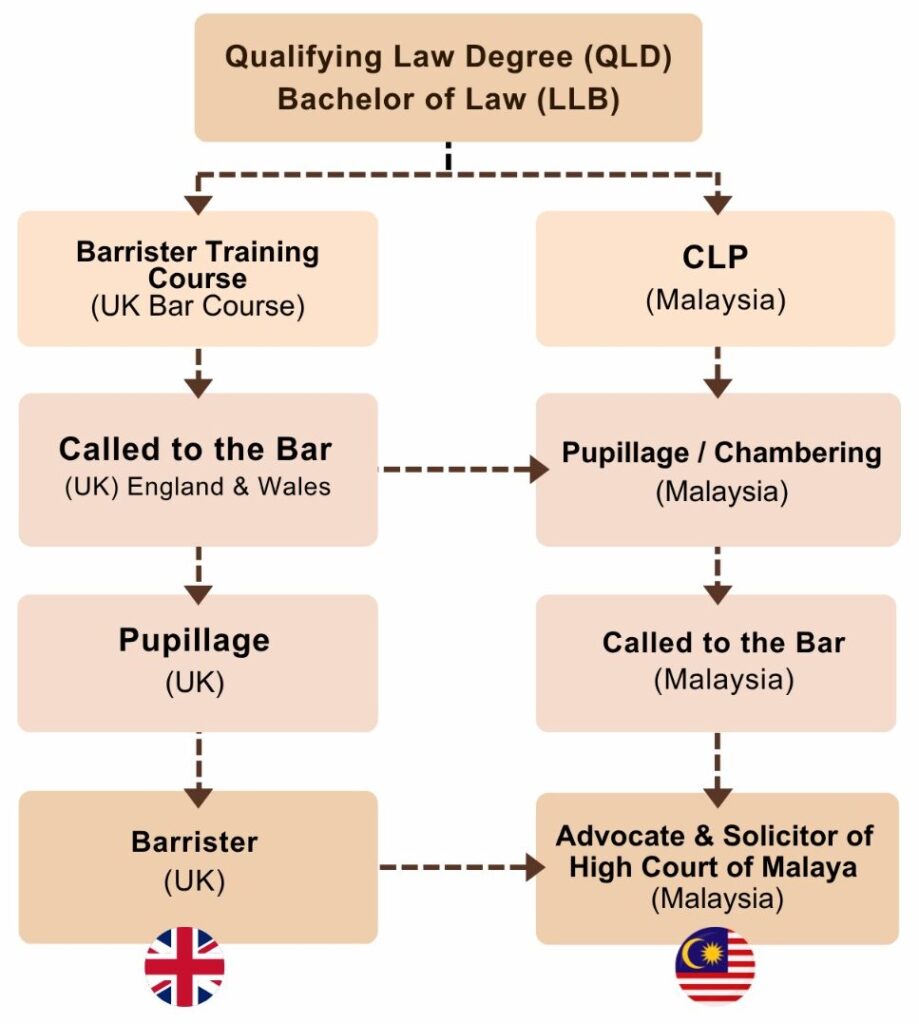
The Ideal Process
Pathways to Practise Law in the UK & Malaysia
General Entry Requirements
Entry requirements vary between Bar course providers, but applicants will generally need to satisfy the following areas.
1. Academic Requirements
- Completion of the academic component of Bar training
- A degree classification equivalent to at least a UK 2:2
- Evidence that all required foundation subjects have been completed
- Membership of one of the four (4) Inns of Court before beginning the course
A stronger academic result may also give students access to a wider range of providers and strengthen future applications for scholarships, pupillage and other competitive opportunities.
Although a 2:2 may satisfy the minimum regulatory requirement, individual Bar schools may impose higher academic or selection criteria.
Academic results are only one consideration. Providers may also assess advocacy potential, written communication, legal reasoning, professional awareness and commitment to a career at the Bar.
2. English Language Requirements
Bar training requires a high level of written and spoken English because students are assessed in areas such as advocacy, legal drafting, conference skills and opinion writing.
Applicants must demonstrate English ability equivalent to at least:
- IELTS Academic: 7.5 in each component; or
- PTE Academic: 73 in each component
The way this requirement is assessed may differ between providers. Depending on the university, an applicant may be asked to submit an English test result or may be assessed through another accepted method.
An exemption or waiver should never be assumed solely because a student has previously studied in English.
UKEC Malaysia can help applicants review the latest requirements of each Bar school before you apply.

If you’re unsure about your eligibility or want advice tailored to your background, feel free to contact us for personalised guidance.
Choosing a Bar School
All authorised Bar courses are intended to prepare students for the vocational component of Bar training, but the student experience can differ significantly between providers.
When comparing Bar schools, students should consider:
- Entry and selection requirements
- Course structure and timetable
- Teaching and advocacy practice
- Assessment methods
- Campus location
- Tuition fees and scholarships
- Inn of Court scholarship timelines
- Cohort size and academic support
- Pupillage and employability support
- Opportunities to combine the Bar course with an LLM
The most suitable Bar school is not necessarily the one with the most familiar name. It is the provider whose requirements, teaching structure and support are best aligned with your profile and professional goals.
The Benefits
The UKEC Advantage Supporting Your Bar Application
Applying for the Bar involves more than submitting a university application.
Students must navigate degree eligibility, provider requirements, Inn of Court membership, scholarship timelines, application documents, selection activities and longer-term professional planning.
UKEC Malaysia brings these different parts of the journey together.
A Long-Standing UK Bar Track Record
UKEC has supported more than 3,000 UK Bar enrolments, giving our team extensive experience with the questions, challenges and decisions commonly faced by Malaysian applicants.
Our guidance is informed not only by application requirements, but also by years of working with Bar schools, law students, graduates and the wider Malaysian legal education community.
Guidance Across All UK Bar Schools
UKEC Malaysia represents all 9 UK Bar course providers.
This allows our counsellors to offer broader comparisons instead of directing every applicant towards the same/a selected few institutions.
We help students assess which providers are realistic and suitable based on their:
- Academic results
- English proficiency
- Preferred intake
- Budget
- Location preferences
- Course structure
- Career direction
Support Beyond Course Selection
Our guidance may include:
- Reviewing your eligibility for Bar training
- Comparing Bar schools and course structures
- Understanding application and selection requirements
- Reviewing application documents
- Planning around Inn of Court membership
- Understanding scholarship opportunities and timelines
- Managing university offers and conditions
- UK student visa guidance
- Pre-departure preparation
We also help students understand what comes after the course, including Call to the Bar, pupillage and the considerations involved when returning to Malaysia.
Direct Access to Bar Schools and Legal Insights
Through initiatives such as the UKEC UK Law Fair, university sessions, applicant workshops, alumni sharing and legal career discussions, students can hear directly from Bar course providers and those who have already completed the journey.
These opportunities allow applicants to ask more informed questions and understand the realities of Bar training beyond what appears in a university prospectus.
A Strong Connection with the Malaysian Law Student Community
UKEC Malaysia has developed long-standing relationships within the Malaysian legal education community, including student societies, law graduates, Bar alumni and former student leaders.
This helps us remain connected to the concerns and experiences of Malaysian applicants—from selecting a law degree to completing Bar training and planning their next professional step.
Plan the Full Journey, Not Only the Next Application
Choosing a Bar course is important, but it should not be treated as an isolated decision.
Before applying, you should understand:
- Whether your academic qualification satisfies the Bar training requirements
- Whether your preferred providers will consider your results
- When to join an Inn of Court
- When to apply for Inn scholarships
- How the provider assesses applicants
- What is required for Call to the Bar
- How your chosen pathway may affect your plans in Malaysia
UKEC Malaysia helps you connect these decisions so that you can approach the Bar with a clearer understanding of both the immediate application and the journey ahead.

Admission Steps
Explore Your UK Bar Options with UKEC Malaysia
Whether you are still completing your LLB, comparing Bar schools or preparing to apply, our experienced counsellors can help you understand your options and plan your next step.
Book a free consultation with UKEC Malaysia to review your UK Bar pathway.
01.
Consultation with UKEC
- Start early (Apr – May, previous year) to plan your UK Bar pathway and shortlist options.
02.
Explore at UK Law Fair
- Attend in July to meet Bar providers and hear from UK Bar alumni.
03.
Prepare Documents
- Draft your personal statement and gather the required documents.
04.
Submit Application
- Apply via UKEC (Oct – Dec) to secure your preferred intake.
05.
Receive Offer
- Offers released (Jan – Mar) may include an interview or selection process.
06.
Meet Requirements
- Complete conditions (Mar – May) including Inns of Court and English requirement.
07.
Post-Application Support
- Final steps (Jun – Aug) results, visa, accommodation, pre-departure.






Speak With Us
Start Early, Plan with Clarity
Beginning your preparation ahead of the application cycle allows you to make better decisions and stay on track throughout the process.